

ISO 22241 is the international standard that defines AdBlue, under its technical name AUS 32. Part 1 sets the quality limits: a urea content of 31.8% to 33.2% by mass, a density of 1,087 to 1,093 kg/m³ at 20°C, and very low maximums for impurities such as metals, phosphate and aldehydes. Fluid outside those limits can damage an SCR system even when it looks perfectly clear. You can check the most important value — urea concentration — yourself, in about a minute, with a refractometer.
The parts of ISO 22241
The standard is published in several parts. Three matter to buyers and fleet operators:
- ISO 22241-1 — Quality requirements. The specification itself: which properties are measured, and the limit for each.
- ISO 22241-2 — Test methods. How a laboratory measures each property, so results from different labs can be compared.
- ISO 22241-3 — Handling, transportation and storage. The materials, cleanliness and storage conditions that keep fluid within specification after it leaves the plant, including the shelf-life table covered in our storage guide.
The key limits in ISO 22241-1
| Property | Requirement |
|---|---|
| Urea content | 31.8–33.2% by mass |
| Density at 20°C | 1,087.0–1,093.0 kg/m³ |
| Refractive index at 20°C | 1.3814–1.3843 |
| Alkalinity as NH3 | 0.2% maximum |
| Biuret | 0.3% maximum |
| Aldehydes | 5 mg/kg maximum |
| Insoluble matter | 20 mg/kg maximum |
| Phosphate (PO4) | 0.5 mg/kg maximum |
| Calcium, iron, aluminium, magnesium, sodium, potassium | 0.5 mg/kg maximum each |
| Copper, zinc, chromium, nickel | 0.2 mg/kg maximum each |
Source: ISO 22241-1:2019. Check the current edition of the standard for contractual use.
What each group of limits protects against
Urea content, density and refractive index
These three measure the same thing from different angles: whether the solution is at the concentration the SCR system expects. The engine control unit calculates how much fluid to inject on the assumption of 32.5% urea. Weak fluid means too little ammonia and higher NOx emissions; strong fluid wastes urea and raises the risk of deposits.
Alkalinity and biuret
Both point to breakdown or poor raw material. Alkalinity, measured as ammonia, rises as urea decomposes, which is why old or heat-exposed fluid can fail it. Biuret is a by-product of urea manufacture that forms solid deposits in the dosing system.
Metals and phosphate
These are the limits that protect the catalyst. Calcium, iron, copper, zinc and the other listed metals, along with phosphate, deposit on the catalyst surface and permanently reduce how well it works. The limits are fractions of a milligram per kilogram, which is why AdBlue must be made with deionised water, never tap or well water, and handled only with compatible equipment.
Insoluble matter and aldehydes
Particles block filters and injector nozzles. Aldehydes indicate lower-grade urea feedstock.
Why you cannot judge AdBlue by eye
Good AdBlue is clear and colourless. So is AdBlue diluted with tap water, AdBlue made from agricultural-grade urea, and AdBlue that has degraded in storage. None of the properties above can be seen. That leaves two practical tools: a quick field test for concentration, and the supplier's documentation for everything else.
How to test AdBlue with a refractometer
An AdBlue refractometer is a handheld optical instrument, inexpensive and widely sold, that reads urea concentration directly from a few drops.
- Calibrate it with distilled water, following its instructions, so it reads zero.
- Take a sample with a clean pipette, from the container or the vehicle tank.
- Place two or three drops on the prism and close the cover plate.
- Read the scale against the light. Most AdBlue refractometers are marked directly in percent urea.
- Compare with the standard. A reading between 31.8% and 33.2% passes. Anything outside that range should not go into a vehicle.
- Clean the prism with distilled water and dry it.
Most models compensate for temperature automatically, but readings are most reliable when the sample is near room temperature.
What to ask a supplier for
- A safety data sheet (SDS) for the product, showing the manufacturer's name and address.
- The values each batch is checked against, and how they are measured.
- Production dates or batch numbers on the packaging, so you can manage shelf life.
- The standard the product is made to, and the status of any certification, stated plainly.
- How the fluid is stored and transported before delivery, especially in summer.
A good supplier answers all of these without hesitation. If a label says "certified" but no one can tell you by whom, treat the claim with caution.
Certification: what it does and does not mean
Three different things are often blurred together:
- Meeting the specification. Fluid that tests within every ISO 22241-1 limit meets the standard, whoever made it.
- Certification. An independent certification body audits a producer's process and product against the standard and issues a certificate. ISO itself writes standards; it does not certify products or issue certificates.
- The AdBlue® trademark. The VDA licenses the AdBlue name to producers whose product meets the standard.
Ask a supplier which of these they are claiming, and for the documents that back it up.
How SiriusBlue approaches quality
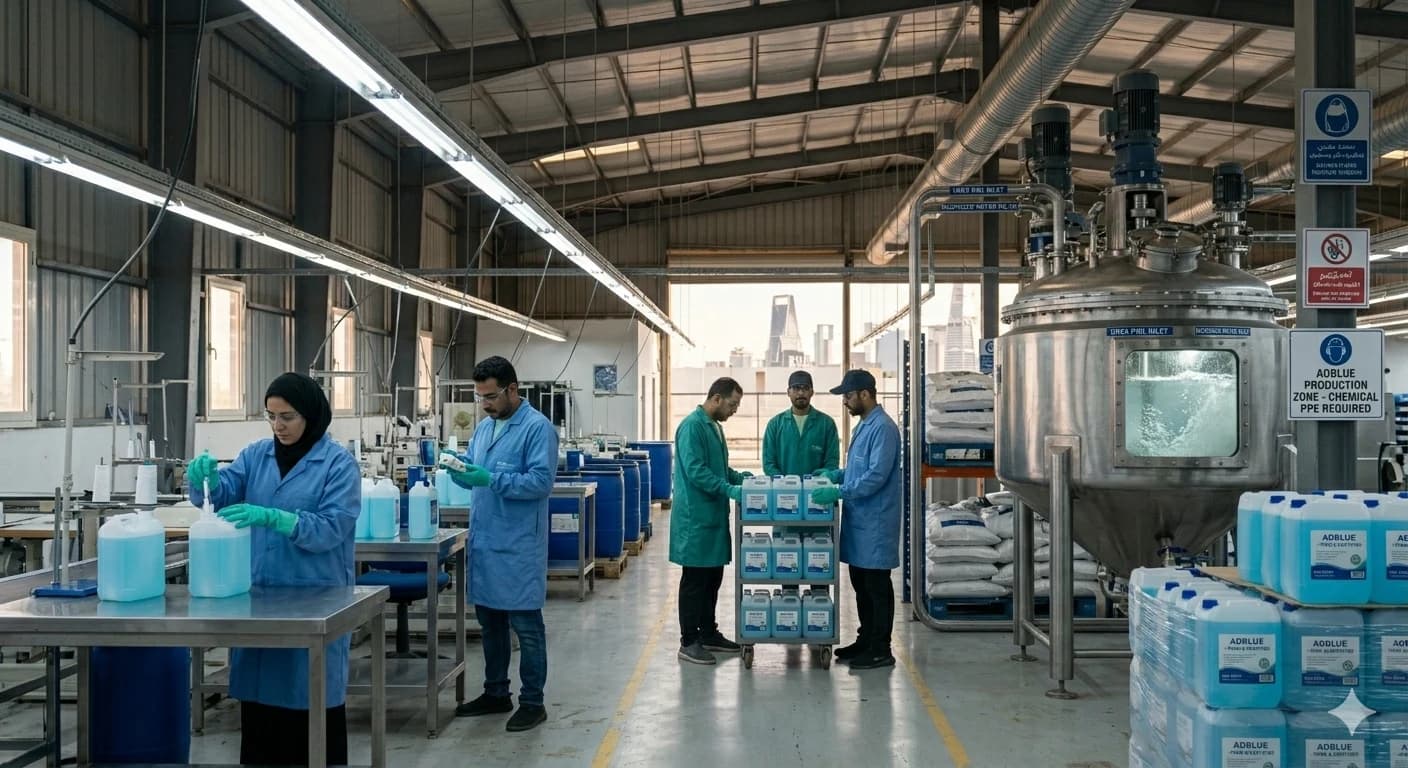
SiriusBlue blends AdBlue at its plant in Riyadh to meet ISO 22241. Every batch is checked against the values on our current safety data sheet before it is released for loading, and we publish those values rather than describe them — you can see them on our homepage. Independent certification of our product is in progress, and we will publish the certificate once it is issued. Until then, we do not describe our product as certified.
Quick answers
What urea concentration should AdBlue have?
32.5% nominally. ISO 22241-1 accepts anything from 31.8% to 33.2% by mass.
Is a hydrometer as good as a refractometer?
A hydrometer checks density, which should be 1,087–1,093 kg/m³ at 20°C. It works, but readings need correcting for temperature and it takes a larger sample, so most workshops prefer a refractometer.
Does ISO 22241 apply to cars and trucks alike?
Yes. The same AUS 32 specification applies to any vehicle or machine with a urea-based SCR system.
Does "ISO certified" on a label mean the product was tested?
Not necessarily. ISO does not certify products. Ask which certification body issued the certificate, what exactly it covers, and whether it is still current.
Key points
- ISO 22241-1 defines AdBlue quality: 31.8–33.2% urea, a density of 1,087–1,093 kg/m³ at 20°C, and strict impurity limits.
- Metal and phosphate contamination is invisible and permanently damages SCR catalysts.
- A refractometer checks concentration on site in about a minute.
- Ask suppliers for the SDS, production dates and the values they test against.
- "Meets ISO 22241", "certified" and "licensed AdBlue" are different claims. Ask which one you are being offered.