


AdBlue is a clear, non-toxic liquid made of 32.5% high-purity urea and 67.5% deionised water. Diesel vehicles with a selective catalytic reduction (SCR) system spray it into the exhaust, where it turns harmful nitrogen oxides (NOx) into nitrogen and water vapour. It is not a fuel additive and it never goes in the diesel tank: it has its own tank, usually behind a blue filler cap.
That is the whole idea in two sentences. The rest of this guide covers what a fleet operator actually needs to know: the names it goes by, how the system uses it, which vehicles need it, how much they use, and what to check before you buy it in Saudi Arabia.
AdBlue, DEF, AUS 32: one fluid, several names
- AdBlue is a registered trademark of the German Association of the Automotive Industry (VDA). It is the name most drivers and workshops use, including in the Gulf.
- DEF (diesel exhaust fluid) is the generic term used in North America and by many equipment makers.
- AUS 32 (aqueous urea solution, 32%) is the technical name used by the international standard, ISO 22241.
- ARLA 32 is the name used in Brazil.
All four describe the same specification. What matters is not the name on the label but whether the fluid inside meets ISO 22241, which we come back to below.
In Arabic you will see it written as أدبلو or ادبلو, or described as سائل عادم الديزل — diesel exhaust fluid.
How an SCR system uses AdBlue
Modern diesel engines run hot and lean to save fuel, and that produces nitrogen oxides. NOx contributes to smog and respiratory illness, so emissions standards limit how much a vehicle may release. SCR is the technology most heavy-vehicle makers use to meet those limits.
The process has four steps:
- A pump draws AdBlue from its tank, and a dosing unit sprays a measured amount into the hot exhaust, upstream of the SCR catalyst.
- The heat breaks the urea down into ammonia and carbon dioxide.
- Inside the catalyst, the ammonia reacts with the nitrogen oxides.
- What leaves the tailpipe is mostly nitrogen and water vapour — already the main components of the air around us.
The engine control unit adjusts the dose continuously, based on engine load and on readings from NOx sensors in the exhaust. That is why fluid quality matters so much: the system assumes it is spraying exactly 32.5% urea. Fluid that is too weak, too strong or contaminated upsets that calculation and can damage the catalyst.
Which vehicles need AdBlue?
Most heavy diesel vehicles built to Euro 4 emissions levels and above use SCR, and virtually all trucks built to Euro 6 (Euro VI) do. In practice that covers:
- Long-haul trucks and tractor units
- Rigid delivery trucks and tippers
- City and intercity buses
- Construction and mining equipment — excavators, loaders and generators with modern engines
- Some diesel vans, pickups and passenger cars
The simplest check is on the vehicle itself. Look for a second filler neck with a blue cap, often next to the diesel filler, or search the owner's manual for "AdBlue", "DEF" or "SCR".
What happens if a vehicle runs out?
Vehicles with SCR are designed so that they cannot keep driving normally without AdBlue. Most modern trucks follow the same sequence: a dashboard warning as the tank runs low, a reduction in engine power once it is empty, and on many models the engine will not restart after it is switched off until the tank is refilled. The exact behaviour varies by manufacturer, but none of it can be overridden by the driver.
For a fleet, running dry means a truck stopped somewhere it cannot easily be reached. That is the practical reason to keep a small stock of sealed jerrycans on vehicles or at depots, even when the main supply is in bulk.
How much AdBlue does a vehicle use?
As a working figure, a diesel vehicle uses AdBlue at around 3–5% of its diesel consumption. A truck that burns 100 litres of diesel needs roughly 3 to 5 litres of AdBlue. The exact rate depends on the engine, the load and how the vehicle is driven.
Across a fleet the numbers add up quickly. Our AdBlue consumption guide works through examples, including a Riyadh–Jeddah run and a monthly calculation for a 20-truck fleet.
Why heat matters in Saudi Arabia
AdBlue is stable, but not forever. Urea slowly breaks down, and the hotter it is stored, the faster that happens. ISO 22241-3 gives a minimum shelf life of 18 months when the fluid is kept at or below 25°C, but only 6 months at a constant 35°C. Summer temperatures in Riyadh regularly pass 40°C, and a closed container or truck body gets hotter still.
Two things follow:
- Where the fluid has been matters. AdBlue that spent weeks in a shipping container or a sun-exposed yard may already have used part of its shelf life before it reaches you.
- How you store it matters. Shade, ventilation and stock rotation make a measurable difference.
The storage and shelf life guide covers this in detail, with the full temperature table.
How to tell good AdBlue from bad
Good AdBlue is clear and colourless. The "blue" is only in the name and the branding. A noticeable smell of ammonia can mean the fluid has started to break down. But neither colour nor smell tells you whether it meets the standard.
These do:
- ISO 22241-1 sets the quality limits: urea content between 31.8% and 33.2%, plus strict maximums for impurities such as calcium, iron, copper and phosphate, which poison the catalyst.
- A refractometer lets you check urea concentration on site in under a minute.
- The supplier's paperwork — a safety data sheet and batch or production dates — tells you what you are buying and when it was made.
Our guide to ISO 22241 and checking AdBlue quality explains each limit and what to ask a supplier for.
Is AdBlue hazardous?
AdBlue is not flammable and is not classed as toxic. It is still a chemical, and it deserves basic care:
- It can irritate eyes and skin. Wear gloves and eye protection when handling it in volume, and rinse with plenty of water after contact.
- It corrodes some metals, including copper, brass, zinc and aluminium, so it should only be stored and dispensed with compatible materials.
- Spills leave white crystals as the water evaporates. Rinse them away with water rather than letting them dry.
The safety data sheet for the specific product gives the full handling and first-aid detail.
Buying AdBlue in Saudi Arabia
When you compare suppliers, the price per litre is only part of the picture. The questions that protect your vehicles are:
- Does the fluid meet ISO 22241, and can the supplier show the values it is checked against?
- How old is it, and how has it been stored and transported?
- Is the packaging right for how you use it? A 1000-litre IBC tote is the cheapest way to supply a depot, but jerrycans are still right for topping up in the field. The packaging guide compares the options.
- Can they deliver on a schedule, to where you need it?
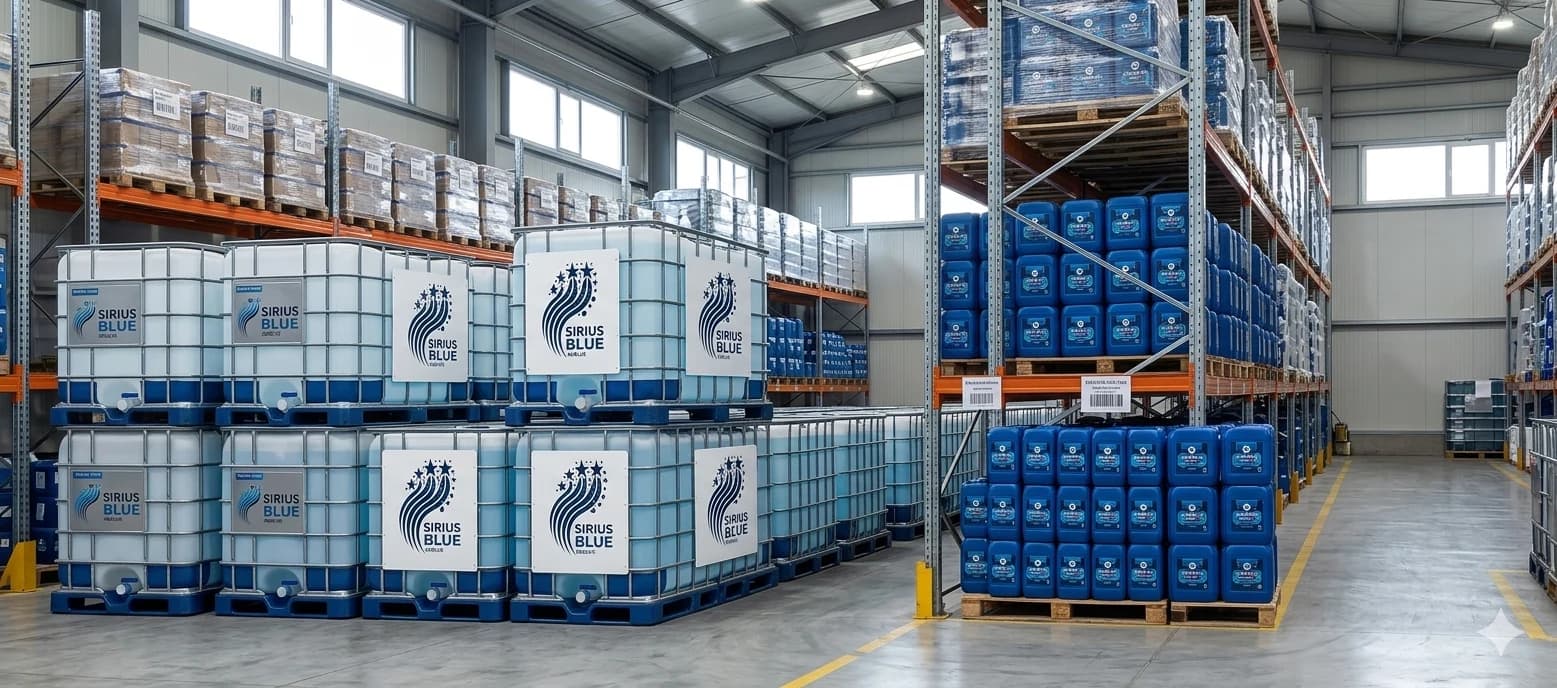
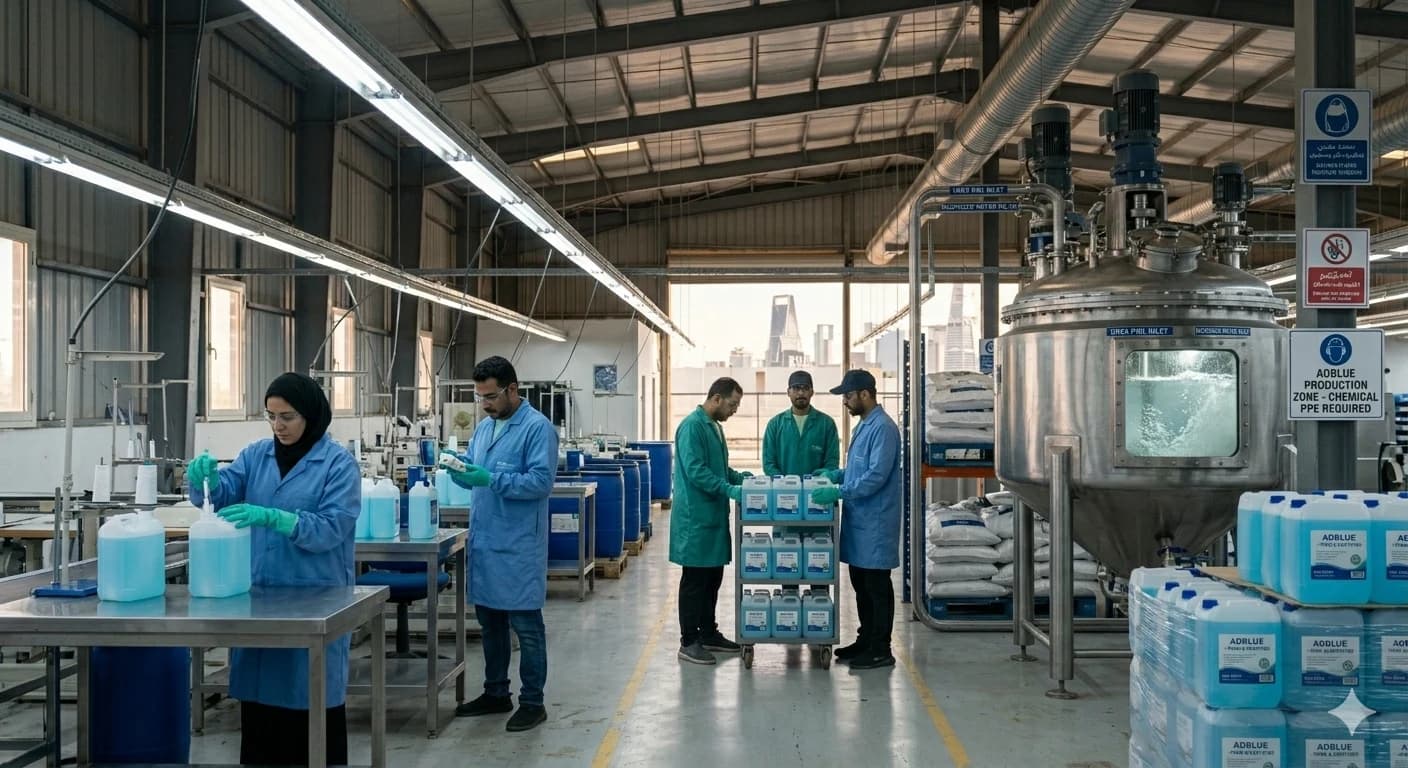
SiriusBlue blends AdBlue at its plant in Riyadh, so the fluid does not spend weeks at sea or in port before it reaches you. It is supplied in 10-litre and 20-litre jerrycans, 200-litre drums on request, and 1000-litre IBC totes, and delivered from Riyadh to every region of the Kingdom on a standing schedule. Our fluid is built to meet ISO 22241. Independent certification is in progress, and the values every batch is checked against are published on our homepage.
Quick answers
Is AdBlue the same as DEF?
Yes. AdBlue is a trademark and DEF is the generic name. Both refer to AUS 32, the 32.5% urea solution defined by ISO 22241.
Can I use water instead of AdBlue?
No. The SCR system needs urea to produce ammonia, and plain water provides none. Tap or well water also carries minerals that deposit on the catalyst and damage it. Diluting AdBlue with water does the same harm on a smaller scale.
Why is it called AdBlue if it is colourless?
The name is a brand. The fluid itself is clear; blue is used on packaging and filler caps so it is easy to tell apart from diesel.
Does AdBlue improve fuel economy?
Not by itself. SCR lets manufacturers tune engines for efficient combustion, which tends to produce more NOx, and then remove that NOx in the exhaust. The fuel saving comes from the engine tuning that SCR makes possible.
Key points
- AdBlue is 32.5% urea in deionised water, used by SCR systems to turn NOx into nitrogen and water.
- It has its own tank and must never be mixed with diesel.
- Most modern heavy diesel vehicles need it, and they lose power if it runs out.
- Expect to use roughly 3–5 litres for every 100 litres of diesel.
- Heat shortens its shelf life, which makes storage and supply chain especially important in Saudi Arabia.
- Quality is defined by ISO 22241, not by colour or brand name.