

Any diesel engine with selective catalytic reduction (SCR) needs AdBlue — and that includes far more than trucks. Generators, excavators, loaders, tower cranes, compressors and other diesel-powered site equipment built to modern emissions standards use the same SCR technology, the same AUS 32 fluid, and the same ISO 22241 specification as a highway truck. The chemistry doesn't change. What changes is how the equipment is used, and that affects how you plan supply.
Why non-road equipment needs it too
Emissions rules for diesel engines have tightened well beyond road vehicles. Generators, construction machinery and other non-road diesel equipment built to current emissions stages reduce nitrogen oxide (NOx) the same way a modern truck does: an SCR catalyst converts NOx into harmless nitrogen and water, using AdBlue as the reducing agent. If a piece of equipment has an SCR system, it needs AdBlue that meets ISO 22241 — there's no separate, lower-grade "industrial" version.
What's different from trucking use
The fluid and the specification are identical. Three things about how equipment is used are not:
Hours, not kilometres
A generator or a stationary compressor doesn't travel, so consumption is tracked in engine hours rather than distance. The underlying relationship is the same as for a truck — AdBlue use tracks diesel use, at roughly the same 3–5% dosing range covered in our consumption guide — but you convert using fuel burned per hour rather than fuel burned per 100 km.
Long, continuous running
A standby or prime-power generator can run for many hours without stopping, and construction equipment on an active site often runs close to full shifts. That means AdBlue tanks on this kind of equipment are drawn down steadily rather than topped up on the same rhythm as a delivery truck's daily route — worth building into a site's refill schedule rather than assuming truck-like intervals.
Remote and temporary sites
Construction sites, remote generators and temporary installations often have no fixed depot nearby. That usually points toward jerrycans — easy to store on site, easy to carry to the equipment, no pump or forklift required — even where a fixed facility would use bulk. See our packaging guide for the full comparison between formats.
Quality matters just as much here — arguably more
A contaminated or diluted fluid damages an SCR catalyst on a generator or an excavator exactly the way it damages one on a truck, and permanently. The difference is that a truck can usually be brought to a workshop; heavy equipment on a remote site often can't be moved as easily, which makes an unplanned SCR fault more disruptive, not less. The same checks apply:
- Buy from a supplier who can show a safety data sheet and the values a batch was tested against.
- Check production dates, especially for equipment that draws down a tank slowly.
- Store jerrycans out of direct sun and away from generator exhaust heat — see our storage guide for what heat actually does to the fluid.
Storage on an active site
A construction or project site is a harder environment for AdBlue than a depot:
- Dust and site debris are a real contamination risk around open containers — keep jerrycans capped between uses.
- Direct sun on metal containers or vehicle decks raises fluid temperature well above ambient, which shortens shelf life.
- Equipment fuel and AdBlue tanks look similar at a glance on some machines. Keep containers clearly labelled to avoid a costly mix-up, which our problems guide covers in more detail.
Planning supply for equipment fleets
For a site running several pieces of SCR equipment, the same approach used for a truck fleet applies:
- Estimate monthly volume from fuel consumption and the 3–5% dosing range.
- Choose packaging by site access — jerrycans for remote or temporary sites, drums or totes for a fixed yard with regular deliveries.
- Build in a buffer sized to how far the site is from a supplier and how disruptive a shortage would be.
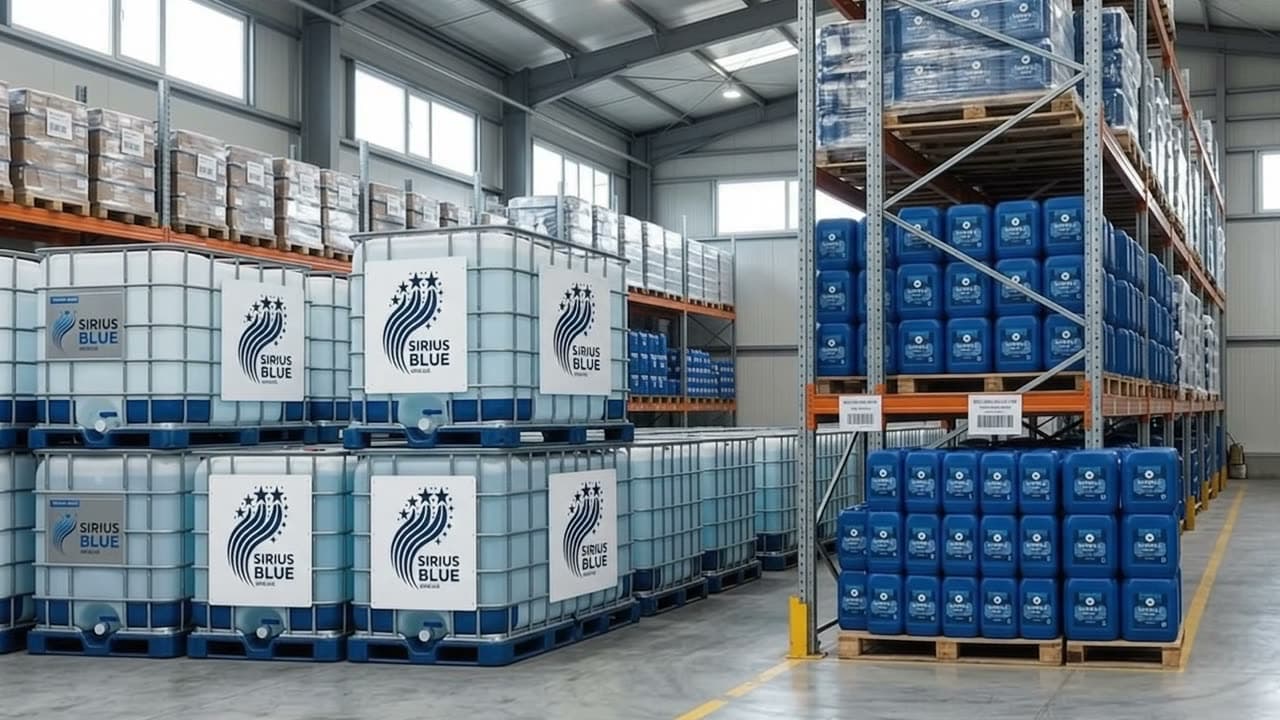
SiriusBlue supplies AdBlue from Riyadh in 10L and 20L jerrycans, 200L drums on request and 1000L IBC totes, with delivery across the Kingdom. Tell us about your equipment and site access and we'll recommend a format and a schedule.
Quick answers
Do generators need the same AdBlue as trucks?
Yes. Any diesel engine with SCR uses the same AUS 32 / ISO 22241 fluid, whatever it's fitted to.
How do I estimate AdBlue use for a generator?
Use the same 3–5% dosing range as for trucks, applied to diesel burned per hour rather than per 100 km. Our consumption guide has the worked examples.
Is there an "industrial grade" AdBlue for machinery?
No. ISO 22241 sets one specification, and it applies to every SCR system regardless of what it's fitted to.
What's the best packaging for a remote construction site?
Usually 10L or 20L jerrycans, unless the site has a fixed depot with regular deliveries and the equipment to handle a 200L drum or 1000L tote.
Key points
- SCR equipment — generators, excavators, loaders, compressors — needs the same AUS 32 fluid as trucks, to the same ISO 22241 specification.
- Track consumption by engine hours rather than distance, using the same 3–5% dosing range.
- Remote or temporary sites usually favour jerrycans over bulk formats.
- Contamination and heat damage SCR catalysts on equipment exactly as they do on trucks.
- Plan supply around site access and how disruptive a shortage would be, not just monthly volume.